Nobody hands you the timeline. You get told recovery “takes time,” which is true and useless, and then you are left to work out for yourself whether month four is supposed to look like this.
So here are the actual numbers, from the people who publish them. Johns Hopkins begins rehabilitation around 24 hours after the cause of a stroke has been treated. The typical hospital stay is five to seven days. Therapy runs up to six times a day while you are there. The first three months are the critical period. Progress slows after six months. And Mayo Clinic notes that performance can still improve 12 to 18 months out.
Here is what each of those stages actually involves, and what matters most in each one.
How long does stroke recovery take?
Most measurable recovery after a stroke happens in the first three months, progress typically slows after six months, and meaningful gains can still come months or years later with focused work.
That is the short answer, and it holds up across sources. Johns Hopkins describes the first three months as the critical period, when rehabilitation and the brain’s own natural recovery reinforce each other. The pattern is consistent enough to plan around. What it does not do is set a deadline. Johns Hopkins rehabilitation specialist Dr. Preeti Raghavan, in guidance updated July 2026, states there is no expiration date on stroke recovery, and that it can continue as long as barriers are being addressed and there are opportunities for learning.
Four things move the timeline more than anything else:
- How severe the stroke was, and which area of the brain it affected
- How quickly the initial treatment was delivered
- The type and intensity of rehabilitation
- Whether setbacks interrupt the process
The timeline, stage by stage
| Stage | What is happening | What matters most |
|---|---|---|
| Day 1 | Stabilising and identifying the stroke type. Rehab often begins around 24 hours after treatment | Speed of medical care |
| First 1 to 2 weeks | Hospital stay, typically 5 to 7 days. Therapy up to 6 times daily. The team maps what the stroke affected | Assessment accuracy, and a discharge plan that matches real capacity |
| 1 to 3 months | The critical period. Spontaneous recovery can return abilities that seemed lost | Intensity, and repetition of the tasks you actually want back |
| 3 to 6 months | Formal rehabilitation often ends in this window. Gains continue but narrow | Not stopping when the programme does |
| 6 to 18 months | The chronic phase. Slower, more specific gains | One clear goal at a time, rather than general therapy |
| Beyond 18 months | Progress still possible, driven by targeted work and new treatments | Coordinated follow-up across the care team |
One note on that third row, because it is where the most avoidable losses happen. The American Heart Association’s stroke rehabilitation guideline says the end of formal rehabilitation, commonly by three to four months, “should not mean the end of the restorative process.” A programme ending is an administrative event. Your recovery does not know the difference.
The part almost nobody warns you about
Early in recovery you will be taught compensatory strategies, which are workarounds that let you do a task a different way. Holding a toothpaste tube so your stronger hand can unscrew the cap. Dressing in a particular order. These are genuinely useful, and often the only way to get daily life moving again.
They also come with a cost that rarely gets mentioned at the time. Dr. Raghavan puts it directly: compensatory strategies are often necessary when someone cannot yet do a task the way they used to, but they can be hard to unlearn later, when doing more becomes possible.
That is the trade worth understanding. A workaround learned in month one can quietly become the ceiling in month eight, because the brain has stopped being asked to solve the original problem. It does not mean refusing compensations. It means revisiting them. Every few months the useful question is: which of these do I still need, and which am I keeping out of habit?
This is one of the strongest arguments for going back for a reassessment even when nothing has obviously changed. What changed may be your capacity, not your symptoms.
Where you go after the hospital, and why
The discharge decision surprises families, because it is based less on how recovered someone is and more on how much therapy they can tolerate. Johns Hopkins sets out three routes:
- Inpatient rehabilitation, if you benefit from physician monitoring and can manage about three hours of therapy per day
- Subacute rehabilitation, if you need a slower course, around one to two hours of therapy daily
- Home, with outpatient therapy as needed
Worth hearing plainly, from Dr. Raghavan: “You don’t have to be at 100% health to return home after a stroke.” If you can manage most daily activities in your own home, or you have family support for them, home is a reasonable destination. Going home is not a verdict on how well recovery is going.
POST-STROKE REHAB IN ROCHESTER
Whatever stage you are at, there is usually a next step.
We provide post-stroke physical therapy across all five Limitless clinics, including for people years past their stroke. Tell us the one task you most want back, and we will build the plan around that rather than around a generic protocol.
What outpatient therapy focuses on at each stage
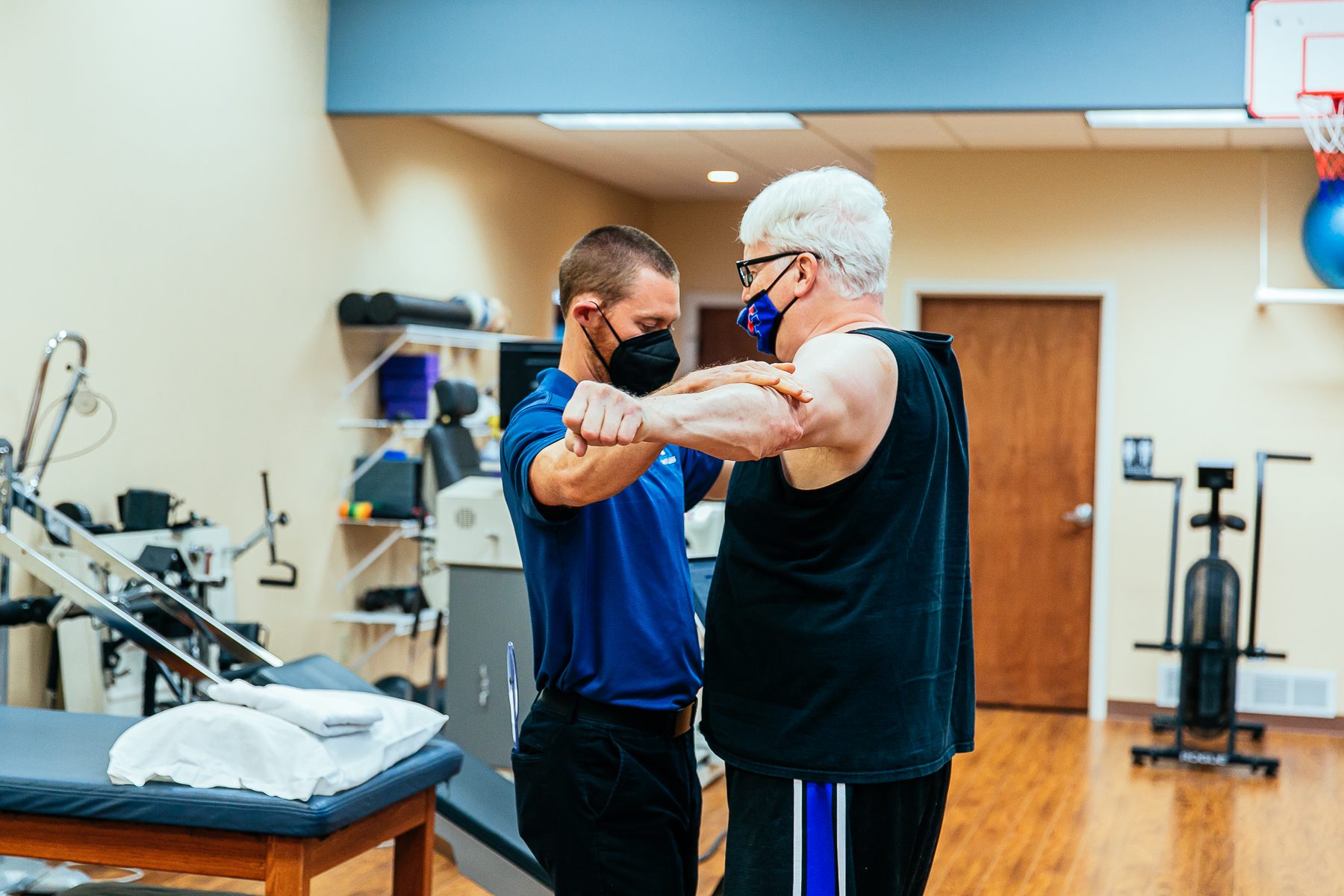
Early on, the work is broad, because so much is changing at once: standing, transfers, walking, using the affected side, endurance. Sessions are frequent and the targets move week to week.
Later it narrows, and that narrowing is a feature rather than a disappointment. In the chronic phase, gains tend to follow a specific goal rather than general conditioning. “I want to carry a mug across the kitchen without using two hands” is a workable target. “I want my arm to be better” is not, because nothing in the plan can be pointed at it.
What we look at alongside the obvious:
- Tone and tightness. Spasticity in an arm or leg changes what is worth training and in what order.
- Balance and fall risk. This often becomes the limiter on independence rather than strength, and it overlaps with our balance and fall preparedness work.
- Fatigue. Heavy fatigue is one of the documented long-term effects of stroke, and a plan written for a good day will not survive an average one.
- The affected hand. Hand and arm function is often where people feel most stuck, and it needs specific work rather than general limb exercise. Our hand therapy team covers the whole upper limb from the shoulder girdle down.
- Keeping the gains. Our neurological wellness classes exist for exactly the period after a formal course ends.
Setbacks are part of the timeline, not a failure of it
Some people hit an interruption in the months after a stroke, and Johns Hopkins names the common ones: pneumonia, a heart attack, or a second stroke. Rehabilitation may need to pause, and goals may need resetting.
This is worth saying out loud only because families often read a setback as the recovery being over. It usually is not. It means the plan needs adjusting with your care team, and that preventing a second stroke, through blood pressure, diabetes management, sleep and activity, becomes part of the rehabilitation conversation rather than separate from it.
Getting post-stroke therapy in the Rochester area
Limitless provides post-stroke physical therapy across all five clinics, in Rochester, Greece, Brighton, Victor and Penfield. Our neuro-rehab programme runs from the Penfield clinic on Panorama Trail South, and we have LSVT BIG certified clinicians in the practice, a protocol built for Parkinson’s whose large-amplitude training principles LSVT Global reports can also help movement problems after a stroke. If you want the wider picture of how neuro rehab is organised here, our guide to neurological physical therapy in Rochester covers it.
Two questions worth asking wherever you go. First, will you be reassessed periodically rather than simply discharged, and second, what happens to the compensations you were taught early on. A clinic that has a real answer to the second question has thought about the long arc rather than the next six visits.
Across fifteen years and more than 5,000 patients and athletes treated, the thing we would most want a family reading this to take away is Dr. Raghavan’s own framing of progress: every time you need less assistance with a task, that is a milestone. You do not have to wait for a dramatic change to be getting somewhere. If you would like someone to look at where you are now, request an appointment and tell us what the stroke took and what you want back.
Frequently Asked Questions
What is the fastest period of stroke recovery?
The first three months. Johns Hopkins calls this the critical period, because rehabilitation and the brain’s natural recovery processes work together during it. Some people also experience spontaneous recovery in this window, where an ability that seemed lost returns as the brain finds another route to the task. Progress after six months is usually slower, though it is still real.
Can you still recover two years after a stroke?
Yes, though gains in the chronic phase are typically slower and more specific. Pick one concrete task and build the plan around it.
How long is physical therapy after a stroke?
There is no fixed length, and that is not evasion, it depends on severity, goals and how you respond. Formal rehabilitation commonly wraps up by three to four months, which is the figure the American Heart Association guideline uses, but the guideline is explicit that this should not be treated as the end of recovery. In practice many people do an intensive early course, then return periodically for reassessment and a new block of work when a specific goal comes into reach. Asking “how long until my next reassessment” is often more useful than asking how long therapy lasts.
Why did my therapy stop if I am still improving?
Usually because you no longer meet the criteria for that level of care, or a visit allowance ran out. Neither is a statement that improvement has finished, and an outpatient plan may still be available.
Should I keep using the workarounds I was taught?
Some, for as long as they genuinely help. But this is worth revisiting every few months rather than settling into permanently. Compensatory strategies are often necessary early, and Johns Hopkins notes they can be hard to unlearn later once doing more becomes possible. The practical approach is to periodically test whether you still need a given workaround, ideally with a therapist watching, because it is difficult to judge from the inside. Dropping one you have outgrown often unlocks more than adding a new exercise.
READY TO LIVE A LIFE WITHOUT LIMITS?
About the Author
This article was written by Dr. Gwen Haffenden, PT, DPT, Team Captain at the Limitless Physical Therapy Specialists clinic in Greece, NY. Dr. Haffenden earned her Doctor of Physical Therapy from SUNY Upstate Medical University in 2023, following a bachelor’s degree in Mind, Body and Movement from the University of Rochester. She is certified in LSVT BIG, a protocol for treating people with Parkinson’s disease, and holds ICE certifications in older adult and orthopedic care. Learn more about Dr. Haffenden and the Limitless team here.