Two things about workers’ compensation physical therapy in New York surprise almost everyone, and both of them change how you should approach it.
The first: workers’ comp physical therapy does require a referral, even though ordinary physical therapy in New York does not. The New York State Workers’ Compensation Board is explicit that treating an injured worker requires a referral from the treating physician, physician assistant, nurse practitioner or podiatrist.
The second: your physical therapist is not allowed to back you up on the part you probably care most about. Under Board rules, physical therapists may not comment on causality of the injury or on your degree of temporary impairment, and their report may not be considered as evidence of either. They may comment on your work status, meaning whether you are currently working, and that is the boundary.
Neither of those is a policy at any one clinic. They are the rules of the system. Knowing them in week one saves a lot of frustration in week six.
How does workers’ comp physical therapy work in New York?
Workers’ comp physical therapy in New York is delivered by a Board-authorized physical therapist, on a referral from your treating medical provider, following the state’s Medical Treatment Guidelines, and billed to the workers’ compensation insurer rather than to you.
The sequence in practice:
- You report the injury and a claim is opened
- A treating medical provider evaluates you and refers you to physical therapy
- You choose a Board-authorized physical therapist
- Treatment proceeds under the Medical Treatment Guidelines, with no prior authorization needed when it stays within them
- Your therapist reports on progress and work status, and bills the carrier directly
The authorization rule that filters your options
Physical therapists must be authorized by the New York State Workers’ Compensation Board to treat injured workers. As of January 1, 2020, all provider types that can be authorized must be, per the Board’s guidance for physical therapists.
This is the practical consequence: a clinic can be excellent, and licensed, and still be unable to treat you on a comp claim. Being a licensed physical therapist in New York and being Board-authorized for workers’ compensation are two different things.
You do not have to take anyone’s word for it either. The Board runs a public Health Care Provider and IME search, so you can check any clinic yourself before you book. Worth doing, because a course of treatment that turns out not to be payable is a mess to unwind.
One more wrinkle worth asking about rather than assuming: some employers participate in a preferred provider arrangement that can affect which provider you use early in a claim. Ask your employer or the Board directly, because it varies.
Who can say what in your claim
This is the table we wish every injured worker got on day one, because most of the friction we see comes from expecting the wrong thing from the wrong person.
| Role | Can | Cannot |
|---|---|---|
| Treating physician, PA, NP or podiatrist | Diagnose, refer you to therapy, comment on causality and impairment | Deliver the physical therapy itself |
| Your physical therapist | Treat you, report progress, comment on your work status | Comment on causality or degree of temporary impairment. Perform an IME |
| Independent medical examiner | Examine you to help resolve disputes, usually at the carrier’s request | Treat you |
| Claim administrator or carrier | Review prior authorization requests, pay or dispute bills | Direct your clinical care |
So if you want your therapist to write that your injury was caused by your job, they cannot, and it is not reluctance. That evidence has to come from your treating medical provider. What your therapist can document is what you can and cannot currently do, which is often the more useful record anyway.
The Medical Treatment Guidelines, and why they usually work in your favour
New York has a mandatory standard of care for comp treatment: the Medical Treatment Guidelines. There are currently 16 of them, covering the most common injuries and illnesses in the system.
People hear “guidelines” and assume restriction. In day-to-day practice the effect is mostly the opposite, because of one rule: physical therapy consistent with the Guidelines does not require prior authorization. No waiting on a carrier to approve each block of visits. Treatment that falls outside the Guidelines does need prior authorization, submitted by the provider through the Board’s online system, OnBoard.
What this means for you is simple. When a clinic that knows the comp system says it can start, it can usually start, and the delay you were braced for often does not materialise.
WORK INJURY REHAB IN ROCHESTER
Hurt at work and not sure where to start?
We accept Workers’ Compensation across all five clinics and handle the reporting side so you can concentrate on getting back to work. Bring us the referral and the claim number, and tell us what your job actually requires.
What good work-injury rehab actually does differently
The clinical work is not exotic. The difference is what the plan is pointed at.
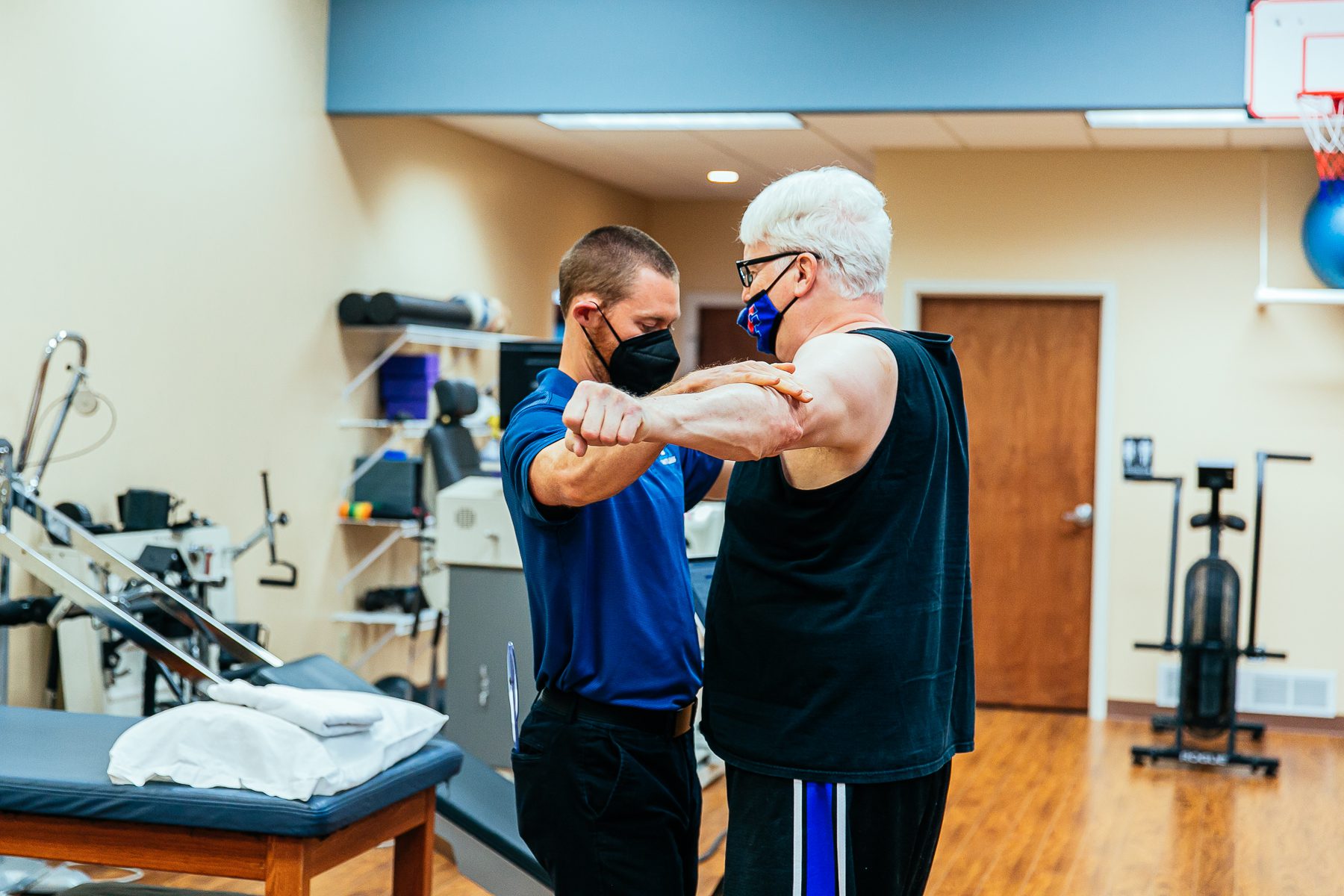
Ordinary rehab aims at getting a joint or region working again. Work-injury rehab has to aim at a specific job, which is a much more concrete target and often a much harder one. “Pain-free walking” is not the goal if your shift involves eight hours on concrete, or lifting to shoulder height four hundred times, or holding a tool in a fixed grip.
So the questions we ask look different:
- What exactly does your job require, in weights, heights, repetitions and hours
- Which of those tasks is currently impossible, and which is possible but costly
- What does a modified-duty version of your role look like, if one exists
- What has to be true before full duty is safe rather than just tolerable
Then the plan works backwards from that. Late-stage work-injury rehab often looks less like therapy and more like a graded rehearsal of the job, because that is what returning to it requires. Underneath it is standard orthopedic physical therapy, and where the injury is post-surgical the plan runs alongside the surgeon’s protocol, the same way our post-surgical rehabilitation works.
Hand and wrist injuries deserve a specific note, because they are common in trades and assembly work and they respond poorly to generic limb exercise. Our hand therapy team covers the whole upper limb from the shoulder girdle down.
Returning to work is a step, not a finish line
The most common mistake we see is treating the return-to-work date as the end of rehabilitation. It usually is not. Going back to a job at reduced capacity, with the original problem only partly resolved, is how a single injury becomes a recurring one.
If modified duty is available, use it as a stage rather than as a compromise. And keep the rehabilitation going through the transition, because the first few weeks back are when the demand jumps and the risk with it.
Getting workers’ comp physical therapy in the Rochester area
Limitless accepts Workers’ Compensation, alongside Medicare, Medicaid, auto and no-fault, and private plans, and we treat work injuries across all five clinics: Victor, Brighton, Greece, Penfield and Cortland. Details are on our patient center page.
Practical things to bring or have ready: your claim number, your employer’s insurance carrier, the referral from your treating provider, and a realistic description of your job’s physical demands. That last one does more to shape a good plan than anything else on the list.
Across fifteen years and more than 5,000 patients and athletes treated, the injured workers who do best are the ones who understand the system they are in. It is administratively fussy and it is navigable, and none of it is a reason to delay getting the injury looked at. If you want to talk through where you are, request an appointment and tell us what happened and what your job needs you to do.
Frequently Asked Questions
Do I need a referral for workers’ comp physical therapy in New York?
Yes. This is the exception to New York’s usual rule, and it catches people out. Ordinary physical therapy in New York can begin with an evaluation and no referral, but the Workers’ Compensation Board requires a referral from your treating physician, physician assistant, nurse practitioner or podiatrist before a physical therapist can treat you on a comp claim. So the order is: see the treating medical provider first, get the referral, then choose your therapist.
Can I choose my own physical therapist on a workers’ comp claim?
Generally yes, from among Board-authorized providers, and you can verify any clinic through the Board’s public provider search. Ask your employer whether a preferred provider arrangement applies, since that can affect early choices.
Will my physical therapist say my injury was work related?
No, and they are not permitted to. Board rules prevent physical therapists from commenting on causality or on the degree of temporary impairment, and their report cannot be treated as evidence of either. They can report on your work status. If you need documentation that the injury is work related, that comes from your treating physician, physician assistant, nurse practitioner or podiatrist. This is worth understanding early, because asking your therapist for something they are barred from providing wastes time you could spend on the claim’s actual paperwork path.
Do I have to pay for workers’ comp physical therapy?
No. Treatment for an accepted claim is billed to the workers’ compensation carrier, not to you, and providers bill using the CMS-1500 form with a medical narrative.
How many visits will workers’ comp approve?
There is no single number, because it is governed by the Medical Treatment Guidelines rather than by a fixed visit cap. The useful thing to know is that therapy consistent with the Guidelines does not require prior authorization at all, so a lot of care proceeds without a per-block approval step. Treatment that goes outside the Guidelines does need prior authorization, which your provider submits through the Board’s OnBoard system. If someone tells you comp “only covers six visits,” ask which Guideline they are referring to.
READY TO LIVE A LIFE WITHOUT LIMITS?
About the Author
This article was written by Dr. Tommy Quinzi, PT, DPT, OCS, at Limitless Physical Therapy Specialists. Dr. Quinzi earned his Doctorate of Physical Therapy from SUNY Upstate Medical University in 2017, following undergraduate study at St. John Fisher, and completed a 12-month residency through Evidence In Motion to become a board-certified Orthopedic Clinical Specialist (OCS). He holds ICE certifications in orthopedics and fitness athlete care, and leads the Limitless University programme mentoring students and emerging clinicians. Learn more about Dr. Quinzi and the Limitless team here.