By Dr. Dan Bajus, PT, DPT, Founder, Limitless Physical Therapy Specialists
Going up the stairs feels fine. Coming down is when your knee complains. That specific pattern, an ache or sharp catch on the front of the knee when you descend stairs, is one of the most common things we see, and the good news is that it usually responds well to the right physical therapy, without injections or surgery.
Here is what is actually happening, why it shows up on the way down and not the way up, and what genuinely helps.
Why does my knee hurt going down stairs?
Knee pain going down stairs most often comes from the patellofemoral joint, where your kneecap (patella) glides over the front of your thigh bone. Descending stairs loads that joint at a steep angle while your thigh muscles work to control your bodyweight, so the pressure behind the kneecap spikes. When the muscles that steer the kneecap are not sharing the load evenly, that pressure becomes pain.
This is why down hurts more than up. Going up, your muscles shorten and push you forward. Going down, they have to lengthen under your full bodyweight to lower you with control, which is a much higher demand on the knee.
What is patellofemoral pain?
Patellofemoral pain is pain around or behind the kneecap, and it is one of the most common knee conditions at every age, affecting a large share of active people at some point (JOSPT, 2019). You might also notice it when you squat, kneel, sit for a long time with the knee bent (sometimes called “theatre sign”), or run downhill.
It is rarely a sign of damage. The kneecap is not slipping out of place, and the joint is not wearing out because you used the stairs. It is a load-and-control problem, and load-and-control problems are exactly what physical therapy is built to fix.
Common causes we see
No two knees are identical, but the drivers behind stair-related knee pain tend to fall into a few buckets:
- Hip weakness. This surprises people. When the muscles on the side and back of the hip are weak, the thigh tends to rotate inward as you lower yourself, which drags the kneecap off its track. The pain is at the knee, but the cause is often at the hip.
- Quad timing and strength. The quadriceps control how your knee bends under load. When they fatigue or fire unevenly, the kneecap gets pulled to one side.
- A sudden change in load. New running mileage, a fresh squat program, a move to a third-floor walkup, or returning to sport after time off can outpace what the joint is ready for.
- Mechanics while running. For runners, stride and cadence matter. Landing with the hip collapsing inward repeatedly stresses the same joint.
What actually helps (and what does not)
The instinct is to rest and avoid stairs. Rest calms the pain for a day, but it does not fix the load-and-control problem, and the pain returns the moment you load the knee again.
The approach with the strongest evidence is targeted exercise. National physical therapy guidelines are clear that a program combining hip strengthening (the muscles on the side and back of the hip) and quadriceps strengthening is the most effective first-line treatment for patellofemoral pain, with benefits that hold up for years (JOSPT, 2019). For runners, retraining your stride and increasing your step rate can take meaningful stress off the joint.
What a good program does:
- Builds hip strength so your thigh stops collapsing inward on every step down.
- Restores quad control so the kneecap tracks evenly.
- Reloads the knee gradually, so it can handle stairs, squats, and sport again instead of avoiding them.
- Addresses the specific thing that set it off, whether that is your running form, your training load, or a strength gap.
Simple starting points
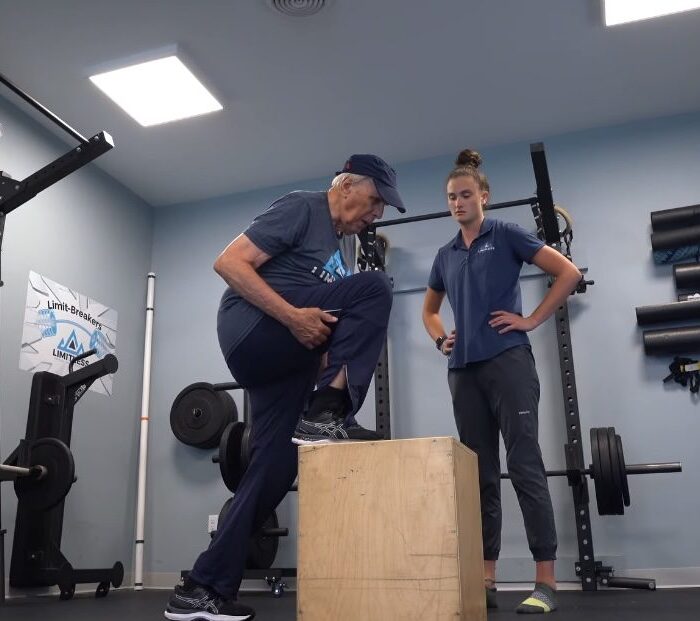
Every knee needs its own plan, so treat these as examples of the direction, not a prescription. In our clinics we often begin with movements like side-lying hip raises, sit-to-stand work, step-downs trained with good alignment, and controlled bridging, then progress the load as the knee tolerates more. The goal is not to chase a burn. It is to retrain how your hip and knee share the work so the stairs stop being a problem.
If a movement produces sharp or worsening pain, that is your signal to adjust it, not push through it. A physical therapist fine-tunes this in person so you are working the right muscles without aggravating the joint.
When to see a physical therapist
Reach out sooner rather than later if your knee pain on stairs has lasted more than a couple of weeks, is limiting activities you care about, or keeps coming back. Early, guided work tends to resolve faster than months of avoiding stairs and hoping it settles.
You do not need a referral to start. New York State allows you to see a physical therapist directly, and most major insurance plans, Medicare, and Worker’s Comp are accepted at Limitless.
How Limitless approaches knee pain
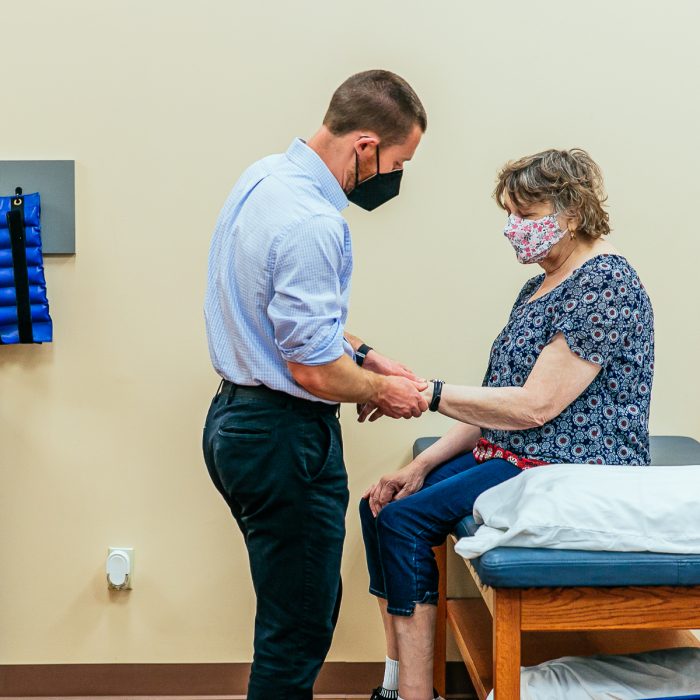
Our team treats the knee as part of the whole chain, hip, knee, and how you move, not just the spot that hurts. Your evaluation looks at your strength, your movement, and the activities you want to get back to, and from there we build a plan that fits your goals. You can read more about our orthopedic physical therapy in Rochester, and if you are an active adult or runner, our work with recreational and competitive athletes is built around getting you back to your sport.
Between visits, the Limitless Life App gives you your exercises, progress tracking, and education so the plan keeps working when you are at home. We see patients across our Victor, Brighton, Greece, and Cortland locations.
Frequently asked questions
Is it bad to keep using stairs with knee pain?
Usually not. Unless a movement causes sharp or worsening pain, staying active is better than complete rest. The aim is to load the knee well, not to avoid it. A physical therapist can show you how to modify stairs in the short term while you build the strength to do them comfortably.
Does knee pain going down stairs mean arthritis?
Not on its own. In active people it is most often patellofemoral pain, a load-and-control issue, not joint damage. An evaluation can tell you what is actually driving it rather than leaving you to guess.
How long does it take to feel better?
Many people notice a meaningful difference within a few weeks of starting a focused program, with continued gains as strength builds. Consistency with your plan is the biggest factor.
Will I need a brace or surgery?
Most people need neither. Targeted exercise is the first-line treatment and resolves the majority of cases. Bracing or imaging is considered only when the picture calls for it. If you have already had a knee replacement, our knee replacement recovery timeline covers what to expect.
Ready to take the stairs without thinking about it?
If knee pain is changing how you move, you do not have to live with it. Our team will find what is driving it and build a plan to fix it.
Ready to live a life without limits? Schedule a consultation at the Limitless clinic nearest you. No referral needed in New York, and most insurance, Medicare, and Worker’s Comp are accepted.
Dr. Dan Bajus, PT, DPT is the founder of Limitless Physical Therapy Specialists. With 15+ years of clinical experience, he and his team have treated more than 5,000 patients and athletes across their Victor, Brighton, Greece, and Cortland clinics, helping people move, feel, and live without limits.