The most effective Achilles tendonitis exercises do something that feels backward at first: they load the sore tendon instead of resting it. Tendons respond to gradual, controlled loading by getting stronger, and rest alone tends to leave them just as sensitive as before. The two things that make loading work are choosing the right exercises for where your tendon hurts, and using a simple pain rule to know how hard to push.
What are the best exercises for Achilles tendonitis?
The best exercises for Achilles tendonitis are calf stretches and slow, controlled heel raises and heel drops, progressed from two legs to one. The American Academy of Orthopaedic Surgeons (AAOS) recommends a wall calf stretch held for 30 seconds and repeated 10 times on each side, plus eccentric strengthening with slow, controlled heel drops for tendinitis in the middle of the tendon (AAOS OrthoInfo, Achilles Tendinitis). AAOS also advises starting heel drops under a physical therapist’s supervision.
Limitless Physical Therapy Specialists treats Achilles tendonitis in runners and active adults at five clinics across the Rochester area and Cortland, NY, with progressive loading programs built around where the tendon hurts and what you want to get back to.
- Calf stretch: gentle, held, and pain-free in the tendon itself
- Heel raises: slow and controlled, two legs then one
- Heel drops: lowering slowly, for mid-tendon pain only
- Return to running: guided by how the tendon feels the next morning
First, find out which Achilles problem you have
Achilles tendonitis comes in two types, and the plan depends on which you have. AAOS describes noninsertional tendinitis as affecting the middle of the tendon, above where it attaches to the heel, and says it is more common in younger, active people, especially runners. Insertional tendinitis affects the lower end, where the tendon attaches to the heel bone, often with bone spurs on the back of the heel.
| Mid-tendon (noninsertional) | At the heel (insertional) | |
|---|---|---|
| Where it hurts | A few inches above the heel, often with thickening | Right at the back of the heel bone |
| Who tends to get it | Younger, active people, especially runners | Any activity level, often with tight calves |
| Heel drops off a step | Recommended by AAOS | Not recommended by AAOS |
| Typical approach | Progressive heel raises and heel drops | Heel raises on flat ground, heel lifts, calf stretching |
Some people have features of both, so if you are unsure, get it assessed before starting heel drops.
The 24-hour pain rule that makes loading safe
Most people with a sore Achilles assume they should stop everything until it stops hurting. A Swedish randomized trial published in the American Journal of Sports Medicine in 2007 tested that assumption (Silbernagel and colleagues; PEDro record). It split 38 people with Achilles tendinopathy into two groups. One group kept running and jumping, guided by a set of pain rules. The other rested from physical activity for the first 6 weeks. Both did the same progressive tendon-loading program for 12 weeks to 6 months.
Both groups improved, and the group that kept training showed no negative effects from continuing to load the tendon. The rules they followed are simple enough to use at home:
- pain during an exercise or a run stays below 5 out of 10
- pain after activity can reach 5 out of 10, but has settled by the next morning
- pain and stiffness do not creep up from one week to the next
Our position: that next-morning check is the most useful tool most people never use. Morning pain and stiffness along the tendon is one of the classic symptoms AAOS lists, which makes it a built-in gauge. If tomorrow morning feels the same or better, today’s load was fine. If it feels worse, ease off for a few days rather than stopping completely.
Here is how that plays out in practice. Say your tendon sits at 2 out of 10 during a set of heel raises and climbs to 4 after an easy run, then feels normal again when you get out of bed. That is inside the rules, so you keep the plan and add a little next time. If the same run leaves you limping down the stairs the next morning, you drop back to the previous week’s load until mornings settle, then build again. The rule turns a vague worry into a daily decision you can actually make.
The bigger point is that a tendon that is never loaded does not get stronger. Rest calms symptoms, but loading is what changes the tendon’s capacity, and the pain rule lets you do it without guessing. If you want help setting the right starting level, you can book an Achilles tendonitis evaluation with our team.
Achilles tendonitis exercises, step by step
The Achilles tendonitis exercises below build from gentle to demanding. Keep each one inside the pain rules above, and move to the next level only when the current one feels easy the next morning.
Wall calf stretch
Face a wall with the sore leg back, heel down and knee straight, and lean in until you feel a stretch in the calf, not pain in the tendon. AAOS suggests holding 30 seconds and repeating 10 times. Repeat with the back knee slightly bent.
Double-leg heel raises
Standing on flat ground and holding a counter for balance, rise onto your toes over about two seconds and lower over about three. Slow lowering is the part that does the most work.
Double-leg heel drops (mid-tendon pain only)
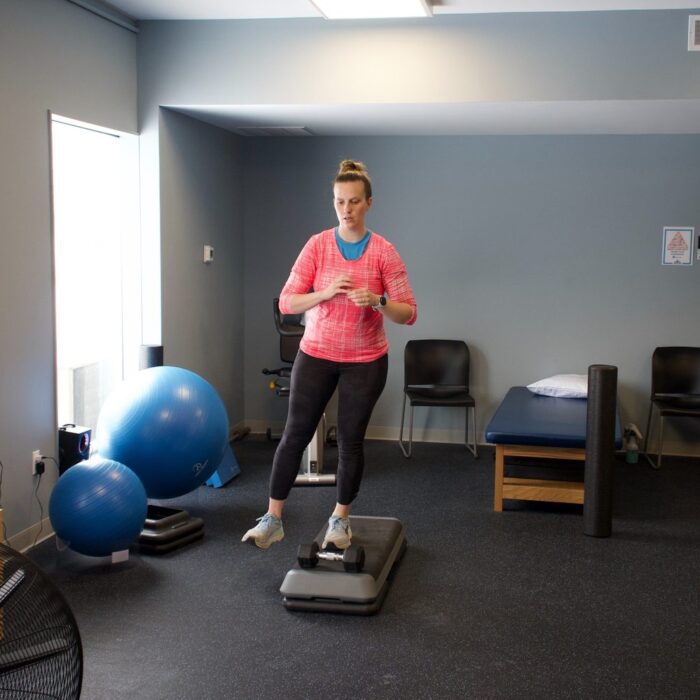
Stand with the balls of your feet on a step and your heels hanging off. Rise up on both feet, then slowly lower your heels below the level of the step. AAOS recommends 20 slow, controlled repetitions. Skip this one if your pain is at the heel bone.
Single-leg heel raises and drops
Once the two-legged version is easy, AAOS recommends progressing to one leg. A simple way to start is to rise on both feet, then lower slowly on the sore side alone.
Adding load and speed
For runners, the final steps are holding light weights during heel raises, then gentle hopping and skipping, then a gradual return to running. This is the stage where a physical therapist’s plan helps most, because the jump from slow strength work to running is where many flare-ups happen.
How long does Achilles tendonitis take to get better?
Achilles tendonitis usually improves over a few months rather than a few weeks. AAOS notes that symptoms may take a few months to improve significantly, that pain can persist beyond 3 months even with early treatment, and that surgery should be considered only if pain has not improved after 6 months of nonsurgical treatment.
Cost and logistics are usually the next question. Limitless works with nearly every major insurance carrier, and our billing team checks your coverage before your first appointment. New York requires a referral within 30 days of your first visit, and our front desk can help with that. You can request your first visit through our new patient form, and our endurance athlete physical therapy team will build the loading plan with you.
ACHILLES TENDON REHAB
Not sure how hard to push your Achilles?
Our team works out which type you have, then sets a loading plan you can run on. We check your insurance before your first visit. Prefer to talk? Call (585) 869-5140.
Book your first visitHeel pain on the underside of the foot is a different problem; see our plantar fasciitis stretches. If the pain sits along the inner edge of your shin instead, see our guide to shin splints treatment, and runners may also find our guide to sports physical therapy useful.
Frequently asked questions
Should I stop running with Achilles tendonitis?
Not always. In the 2007 Silbernagel trial, people who kept running under pain rules did as well as those who rested. Keep pain during running below 5 out of 10, and make sure it settles by the next morning.
Is heat or ice better for Achilles tendonitis?
AAOS recommends ice for up to 20 minutes at a time on the painful area.
What shoes help with Achilles tendonitis?
Supportive shoes and heel lifts can take some strain off the tendon, and AAOS lists both among nonsurgical options. A heel lift raises the heel slightly, which shortens the distance the tendon has to stretch with each step. That can be especially useful for insertional tendinitis at the heel bone, where stretching the tendon over the bone is what hurts. AAOS also notes that night splints can ease morning pain, and that a walking boot may be used briefly, though extended use is discouraged. Shoes are a helper rather than a cure. The tendon still needs progressive loading to get stronger, so think of footwear as a way to make the exercise program easier to stick to.
When should I see a doctor about my Achilles?
Right away if you felt a sudden pop in the calf or heel, which AAOS flags as a possible tear. Otherwise, if pain keeps building over a few weeks despite sensible changes, a physical therapist can assess which type you have and set up a plan.
READY TO LIVE A LIFE WITHOUT LIMITS?
About the Author
This article was written by Dr. Erin Davis, PT, DPT, CSCS, at Limitless Physical Therapy Specialists. Dr. Davis earned her Doctorate of Physical Therapy from Springfield College and became a Certified Strength and Conditioning Specialist during her final year of physical therapy school. She focuses on active people of all ages, combining progressive strength training with evidence-based rehabilitation, and outside the clinic she runs, skis, does CrossFit and coaches strength and conditioning for youth athletes. Learn more about Dr. Davis and the Limitless team here.