
You changed your pillow. You tried sleeping on your back. You even bought a new mattress. But every morning, the same thing—your arm aches, tingles, or goes completely numb from sleeping on your side.
Here's the part nobody tells you: most advice online is written for shoulder pain, not arm pain. And the difference matters more than you'd think.
Arm pain from sleeping on your side usually comes down to nerve compression—not a joint problem. When you lie on one side for hours, your body weight presses down on the nerves running through your shoulder and arm. That sustained pressure restricts blood flow, irritates nerve tissue, and creates the pain, numbness, or tingling you feel in the morning.
The good news? Once you understand which nerve pathway is involved, fixing the problem gets a lot more straightforward. After treating over 5,000 patients across our Victor, Brighton, Greece, and Cortland clinics, our team at Limitless Physical Therapy has seen this pattern hundreds of times—and we've helped patients break through it.
Why Does Your Arm Hurt After Sleeping on Your Side?
Arm pain from sleeping on your side happens when sustained pressure compresses the nerves running from your neck through your shoulder and down your arm. Unlike shoulder pain—which involves the joint itself—arm pain from side sleeping is primarily a nerve compression and blood flow issue that affects the upper arm, forearm, or hand.
Three things are happening while you sleep on your side that create this problem.
Nerve compression. Your arm has three major nerve pathways passing through it. When you lie on your side, your body weight pins these nerves against bone, muscle, or the mattress for hours at a time. Research from Washington University School of Medicine confirms that low-level compressive stress on a nerve over a prolonged period can impair blood flow, alter nerve conduction, and cause pain or numbness.
Reduced blood flow. Gravity pulls blood downward when you're lying on your side. The arm underneath you gets less circulation, which means the nerve tissue doesn't get the oxygen it needs. That's why you sometimes wake up unable to feel your arm at all.
Muscle tension and positioning. If your arm is tucked under your pillow or bent sharply at the elbow, you're adding mechanical stretch on top of compression. That combination accelerates the irritation.
The reason most online advice doesn't help? It's focused on rotator cuff issues, bursitis, and shoulder impingement—joint problems. If your pain runs down your arm, into your forearm, or makes your fingers tingle, the cause is almost certainly nerve-related. And that calls for a different fix.
Three Nerve Pathways Behind Side-Sleeper Arm Pain
At our Victor and Brighton clinics, we see patients every week who describe arm pain from sleeping but can't pinpoint exactly where it hurts. That's because three different nerves can be involved—and each one creates a distinct pattern. Matching your symptoms to the right nerve is the first step toward actually solving the problem.
1. Brachial Plexus — The "Whole Arm" Ache
The brachial plexus is a bundle of nerves that runs from your neck, under your collarbone, and into your arm. When you sleep on your side, your body weight compresses this bundle against the mattress. The result is a deep, heavy ache that spreads through your entire arm—shoulder to hand. Some people describe it as their arm feeling "dead" when they wake up.
Telltale signs: Deep aching from shoulder to fingers, heavy or weak-feeling arm, takes several minutes to regain full sensation after waking.
2. Ulnar Nerve — The "Funny Bone" Tingling
The ulnar nerve wraps around the inside of your elbow. If you sleep with your elbow bent past 90 degrees—which most side sleepers do—this nerve gets stretched and compressed simultaneously. The tingling shows up in a very specific spot: your ring finger and pinky finger, plus the inner edge of your forearm.
Telltale signs: Tingling or numbness in ring and pinky fingers, "funny bone" sensation, inner forearm discomfort, sometimes grip weakness in the morning.
3. Median Nerve — The "Pins and Needles" Numbness
The median nerve travels through the carpal tunnel in your wrist. If you sleep with your wrist flexed (curled under your pillow or against the mattress), this nerve gets compressed. A study published in the Journal of Hand Surgery found a strong association between side sleeping and carpal tunnel symptoms, particularly in people under 60.
Telltale signs: Numbness or pins and needles in your thumb, index finger, and middle finger. Pain may wake you up at night rather than just being present in the morning.
Here's how to match your symptoms:
| Nerve Pathway | Where You Feel It | What It Feels Like | Common Sleep Trigger |
| Brachial plexus | Whole arm, shoulder to hand | Deep ache, heaviness, arm feels "dead" | Lying directly on shoulder/arm |
| Ulnar nerve | Ring + pinky fingers, inner forearm | Tingling, "funny bone" sensation | Elbow bent past 90° during sleep |
| Median nerve | Thumb, index + middle fingers | Numbness, pins and needles | Wrist flexed or tucked under pillow |
If your symptoms match more than one pattern, that's not unusual. We frequently see overlap, especially in patients who sleep with their arm tucked under their head—that position compresses the brachial plexus and bends the elbow and wrist.
Is Your Arm Pain From Sleeping or Something Else?
Most arm pain from side sleeping follows a predictable pattern: it's there when you wake up and fades within 5 to 30 minutes once you start moving. That's positional compression, and it's very manageable.
But sometimes arm pain during sleep signals something that needs professional attention. Here's how to tell the difference.
Signs it's positional (and fixable at home):
- Pain or numbness only happens after sleeping and resolves quickly
- Symptoms match one of the three nerve patterns above
- Moving your arm, shaking it out, or changing positions brings relief
- You can reproduce it by sleeping in the same position
Signs you should get evaluated:
- Arm pain that persists for hours after waking, or lasts throughout the day
- Progressive weakness in your hand or grip that isn't improving
- Pain that travels from your shoulder to your elbow and doesn't go away with repositioning
- Numbness that doesn't resolve with movement
- Symptoms in both arms simultaneously (this can indicate a cervical spine issue)
Many of our Rochester-area patients come in thinking their arm pain is "just from sleeping weird." Sometimes it is—and a few adjustments fix it completely. Other times, the sleeping position is revealing an underlying issue like thoracic outlet syndrome or a cervical disc problem that compression during sleep aggravates. Either way, understanding what's happening puts you in control.
You don't have to accept morning arm pain as normal. Your body has remarkable healing abilities when supported properly—and often, the right information is all you need to start feeling better.
How to Stop Arm Pain From Side Sleeping Tonight
You don't have to stop sleeping on your side. You need to take the pressure off the nerves. Here are the adjustments our physical therapy team recommends, matched to the nerve pathway causing your symptoms.
1. Support Your Bottom Arm With a Pillow
Place a firm pillow lengthwise in front of your torso. Rest your bottom arm on it so your arm isn't pinned between your body and the mattress. This lifts the arm, reduces brachial plexus compression, and keeps blood flowing. For more details on pillow setups, see our guide to the best pillow for side sleepers with shoulder pain.
2. Keep Your Elbow Below 90 Degrees
If your ulnar nerve is the issue (tingling in the ring and pinky fingers), the fix is elbow position. Wrap a soft towel loosely around your elbow before bed to prevent it from bending too far during sleep. Some patients use a foam elbow pad. The goal is keeping the angle open to reduce stretch on the ulnar nerve.
3. Keep Your Wrist Neutral
For median nerve symptoms (thumb, index, and middle finger numbness), a lightweight wrist brace worn at night can prevent your wrist from curling. Occupational therapists at Washington University's Milliken Hand Rehabilitation Center recommend keeping the hand flat on a pillow to avoid compressing the carpal tunnel.
4. Use a Body Pillow to Control Position
A full-length body pillow prevents you from rolling fully onto your shoulder during the night. Hug it to keep your top arm supported and your bottom shoulder from bearing your full weight. Our clinical experience shows patients who add a body pillow report reduced morning arm pain within the first week.
5. Check Your Mattress Firmness
A mattress that's too firm doesn't let your shoulder sink in, which forces more weight onto the arm. A mattress that's too soft lets your body collapse, increasing nerve compression. Medium-firm is what we typically recommend for side sleepers. For a full breakdown of positioning, check out our best sleeping position for shoulder pain guide.
[VISUAL PLACEHOLDER: Side-by-side diagram showing incorrect arm position (pinned under body) vs. correct position (supported on pillow, elbow open, wrist neutral)]
Quick Reference: Match Your Nerve to Your Fix
| If You Feel This... | The Nerve Involved | Try This Tonight |
| Deep ache, whole arm feels heavy/dead | Brachial plexus | Pillow under arm + body pillow |
| Tingling in ring/pinky fingers | Ulnar nerve | Towel wrap at elbow + keep arm straighter |
| Numbness in thumb/index/middle fingers | Median nerve | Wrist brace + keep hand flat on pillow |
PT-Approved Stretches for Arm Pain Relief
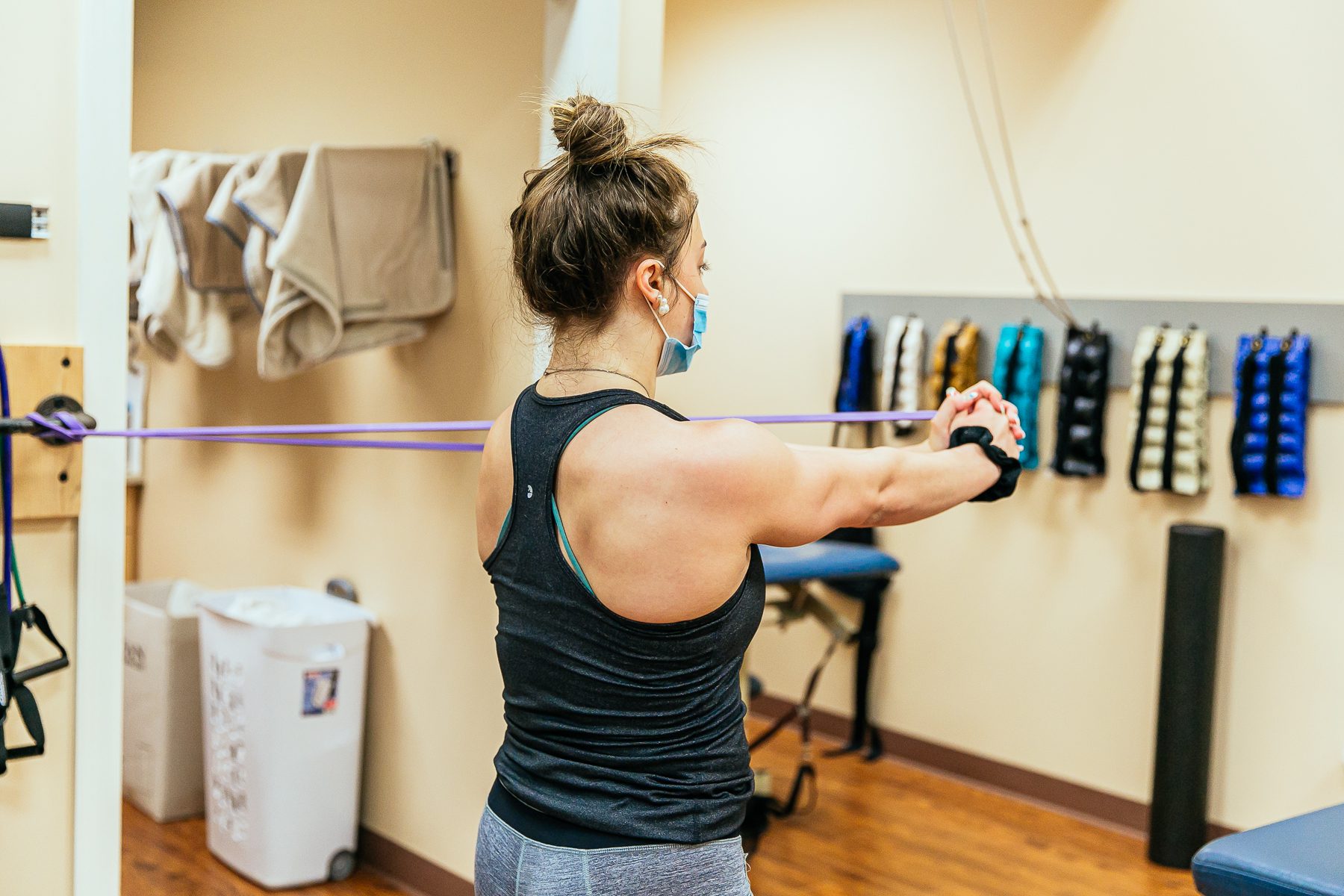
These nerve glide exercises help restore mobility and reduce irritation in the three nerve pathways. Do them before bed and again in the morning if you wake up with symptoms. Hold each position gently—nerve glides should create a mild stretch, never sharp pain.
Brachial Plexus Glide
Stand with your affected arm at your side. Tilt your head away from that arm (ear toward opposite shoulder). Slowly extend your arm out to the side with your palm facing the floor. You should feel a gentle pull from your neck through your arm. Hold for 5 seconds. Return to neutral. Repeat 10 times.
Ulnar Nerve Glide
Extend your arm in front of you, palm facing up. Bend your elbow, bringing your hand toward your face—like you're looking at a watch. Then rotate your wrist so your palm faces outward, and gently straighten your arm to the side. You'll feel a stretch along the inside of your elbow and forearm. Hold 3 seconds at the end range. Repeat 8–10 times.
Median Nerve Glide
Extend your arm straight out to the side, palm facing forward (like a traffic cop's stop signal). Gently pull your fingers back toward you with the opposite hand until you feel a stretch along the inside of your forearm and wrist. Hold 5 seconds. Repeat 8–10 times.
Sleeper Stretch (Posterior Shoulder)
Lie on your affected side with your arm at 90 degrees in front of you, elbow bent. Use your opposite hand to gently press your forearm toward the mattress. This stretches the posterior shoulder capsule, reducing overnight compression. Hold for 20–30 seconds. Repeat 3 times.
After treating thousands of patients with sleep-related arm and shoulder pain from sleeping on their side, including many who also deal with elbow pain when sleeping, our clinicians consistently find that patients who combine nerve glides with the positioning changes from the previous section see the fastest improvement. Stretching alone helps—but pairing it with the right sleep setup makes the difference between temporary relief and lasting results.
When Physical Therapy Helps Arm Pain From Sleeping
If you've tried the positioning changes and stretches for two to three weeks without improvement, or if your symptoms are getting worse, it's worth getting a professional evaluation.
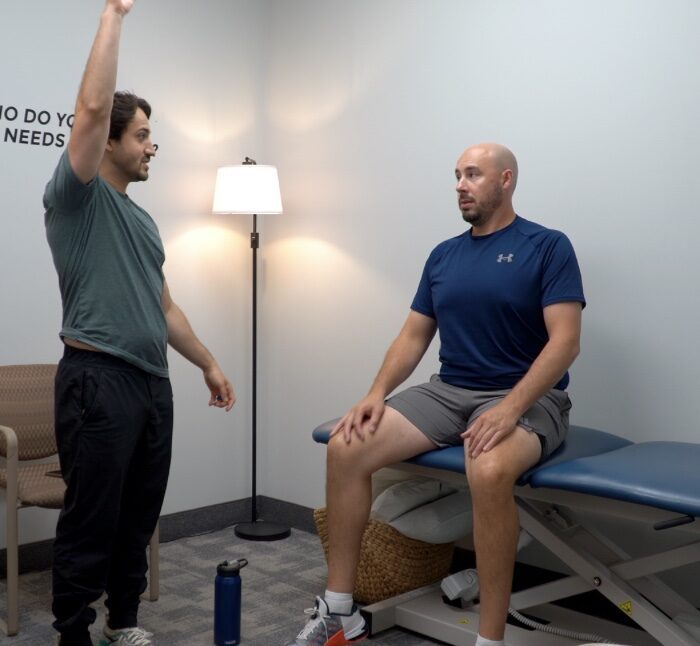
Here's what a physical therapy assessment for arm pain typically covers at Limitless PT:
Nerve tension testing — We test each of the three nerve pathways individually to pinpoint exactly where compression is occurring. This tells us whether the issue is at the shoulder, elbow, wrist, or cervical spine.
Range of motion and strength screening — Weakness or limited movement can indicate that the nerve has been compressed long enough to affect function.
Postural assessment — Rounded shoulders and forward head posture during the day can contribute to nerve compression at night. We evaluate your daytime mechanics alongside your sleep setup.
Sleep position analysis — We work with you to modify your sleep environment based on exactly which nerve is involved. No generic advice—your plan fits your body.
Many of our patients are surprised by how quickly things improve once the right nerve pathway is identified and treated. We want to be your guide to better health, not just a temporary fix.
Frequently Asked Questions
Can sleeping on your side cause permanent arm damage?
Positional nerve compression from side sleeping rarely causes permanent damage. Your body's pain and numbness signals are designed to wake you up before lasting harm occurs. However, repeated nerve irritation over months or years can lead to persistent symptoms like chronic tingling or grip weakness. If your arm pain isn't improving with position changes, a physical therapist can evaluate whether the nerve needs targeted treatment to recover fully.
Why does only one arm go numb when I sleep on my side?
The arm you're lying on bears the majority of your body weight, compressing nerves and restricting blood flow. Your top arm is essentially unloaded and free from that pressure. If both arms go numb or tingle during sleep, that's a different pattern—it may indicate a cervical spine issue rather than positional compression—and should be evaluated by a professional.
Should I stop sleeping on my side if my arm hurts?
Not necessarily. Side sleeping is the most common sleep position, and most people can continue doing it comfortably with the right modifications. Supporting your bottom arm on a pillow, keeping your elbow under 90 degrees, and maintaining a neutral wrist position can solve the problem without changing your preferred sleep style.
How long does arm pain from sleeping in a bad position last?
Positional arm pain and numbness typically resolve within 5 to 30 minutes of waking up and moving around. If your symptoms last longer than an hour, recur daily despite position changes, or include persistent weakness, that pattern suggests something beyond positional compression. Schedule an evaluation to rule out underlying nerve or cervical spine conditions.
Arm pain from sleeping on your side isn't something you need to accept. It has specific causes—nerve compression along three distinct pathways—and each one has a targeted fix. Match your symptoms to the right nerve, make the positioning changes tonight, and give the stretches two to three weeks.
If it's still there after that, your body is telling you something worth investigating further. Together, we'll create a plan that empowers you to thrive.
Ready to live a life without limits? Schedule your evaluation at Limitless Physical Therapy — with locations in Victor, Brighton, Greece, and Cortland — and get back to waking up pain-free.
About the Author
Dr. Dan Bajus, PT, DPT [Photo placeholder] Dr. Bajus is the founder of Limitless Physical Therapy Specialists with over 15 years of clinical experience treating orthopedic and nerve-related conditions across Victor, Brighton, Greece, and Cortland, NY. He and his team have helped more than 5,000 patients get back to doing the things they love with the people they love.
![Arm Pain From Sleeping on Side: Causes and Fixes [PT Guide]](https://limitlesspts.com/wp-content/plugins/theplus_elementor_addon/assets/images/placeholder-grid.jpg)