Last updated: May 2026
Shoulder Impingement Physical Therapy: What Actually Works (and Why “Impingement” Is the Wrong Word)
If you’ve been told you have shoulder impingement, the recommended treatment was probably some combination of rest, anti-inflammatories, and physical therapy. The advice to do PT is right. The framing of why it works has been wrong for about a decade, and that matters because the wrong framing leads to the wrong exercises. This article walks through what’s actually happening in most “impingement” cases, what physical therapy targets, and why the old “stretch and strengthen the rotator cuff” advice misses the most important piece.
The framework here draws on the current orthopedic and physical therapy literature, particularly the Dutch Orthopaedic Association’s multidisciplinary guideline on subacromial pain syndrome and recent JOSPT systematic reviews on conservative management, plus what we see clinically across our Limitless PT clinics.
Why “Impingement” Is the Wrong Word
The term “shoulder impingement” implies a mechanical problem: the rotator cuff tendons get pinched between the head of the upper arm bone and the underside of the acromion (the bony hood over the shoulder). For decades, treatment was built around relieving that pinching, often surgically.
The problem is that the mechanical impingement story doesn’t match the evidence. Many people with painful shoulders have plenty of subacromial space on imaging, and many people with reduced space have no pain. The current consensus, reflected in the term subacromial pain syndrome (SAPS) used in the Dutch and other European guidelines, treats the condition as a multifactorial problem of the rotator cuff and surrounding tissues, not a simple pinch.
This isn’t just semantics. If you treat a problem as mechanical impingement, your interventions focus on creating space (stretching the front of the shoulder, surgically shaving the acromion). If you treat it as a tissue overload and motor control problem, your interventions focus on building rotator cuff capacity and improving how the shoulder blade moves. The second approach has better outcomes for most patients.
The Three Mechanisms Behind Impingement-Pattern Pain
When a patient comes in with the textbook impingement pattern (pain on overhead reach, painful arc between 60 and 120 degrees of elevation, pain sleeping on the affected side), one of three things is usually driving it. The treatment differs. If night pain is your main complaint, our guide to shoulder pain from sleeping covers the positions that take pressure off the joint.
Mechanism 1: Primary Structural Impingement (the minority)
A small number of patients genuinely have a bony or anatomic narrowing of the subacromial space. Type III (hooked) acromion, large bone spurs, or significant calcific tendinitis can mechanically reduce the space available for the supraspinatus tendon to glide.
How to identify: Imaging-confirmed bony anatomy issues, often with persistent symptoms despite high-quality conservative treatment.
What PT focuses on: Tissue tolerance, posture, scapular mechanics. PT often helps significantly even with structural narrowing because the pain in these patients is driven by tendon overload, not the narrowing itself. Some patients in this group eventually need surgical decompression.
Mechanism 2: Scapular Dyskinesis (the most common)
The scapula (shoulder blade) has to rotate and tilt as the arm goes overhead. When the scapula doesn’t move correctly (often because of weakness in the lower trapezius and serratus anterior, tightness in the pectoralis minor, or postural patterns from desk work), the rotator cuff has to do its job in a mechanically unfavorable position. The tendon gets overloaded. Pain follows.
How to identify: Visible asymmetry of scapular movement when the arm is raised, pain that improves when scapular position is corrected, often accompanied by upper trap dominance and rounded-shoulder posture.
What PT focuses on: Scapular stability and motor control. Lower trap and serratus anterior strengthening, postural retraining, pectoralis minor mobility. This group responds quickly to good PT, often within 6 to 8 weeks.
Mechanism 3: Rotator Cuff Weakness or Imbalance (also common)
The rotator cuff has four muscles. They have to work together to keep the head of the humerus centered in the socket while you move. When the cuff is weak or imbalanced (often the supraspinatus and infraspinatus relative to stronger anterior structures), the humeral head migrates upward during arm elevation, increasing load on the supraspinatus tendon.
How to identify: Demonstrable weakness on cuff-specific testing (empty can, external rotation at 0 and 90 degrees), often with normal scapular mechanics.
What PT focuses on: Progressive rotator cuff strengthening, with attention to eccentric loading and progressive resistance. Recent meta-analyses cited in the JOSPT literature find supervised and home-based progressive shoulder strengthening to be effective for subacromial impingement / SAPS.
In typical outpatient orthopedic practice, scapular dyskinesis is the largest single subgroup, often appearing in patients with prolonged desk work, forward-rounded shoulder posture, and weak lower-trapezius and serratus anterior musculature. Rotator cuff weakness or imbalance is the next most common pattern, frequently seen in recreational lifters who emphasize pressing over pulling and in active adults returning to overhead sport without adequate cuff conditioning. Primary structural narrowing accounts for the smallest subgroup and tends to appear in older patients (typically over 55) with degenerative bone-spur changes visible on imaging. These three patterns aren’t mutually exclusive; about a third of patients show meaningful contributions from more than one.
What PT Actually Does for Shoulder Impingement
A typical PT episode of care for impingement looks like this:
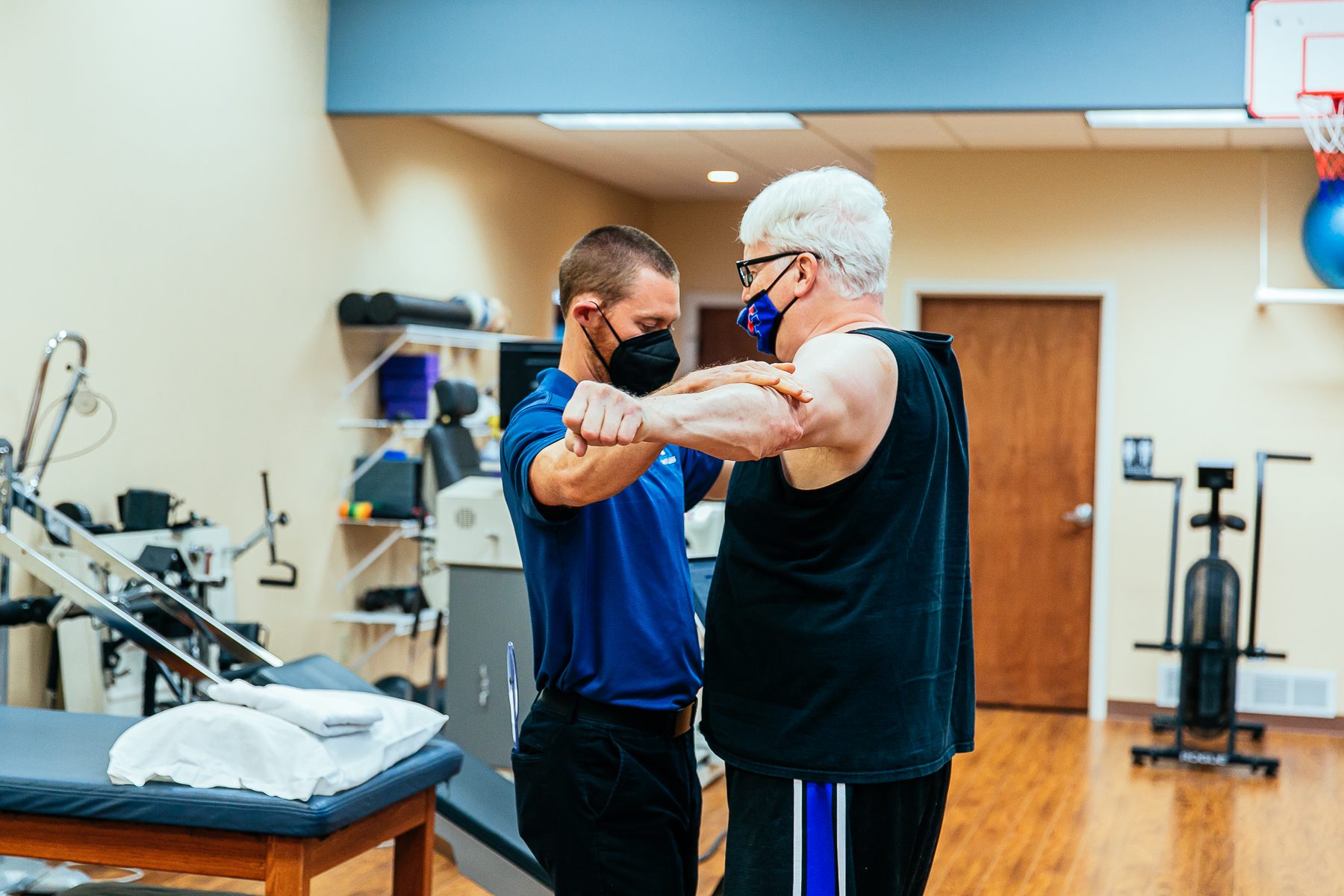
Visit 1 (evaluation): Range of motion, strength testing, scapular mechanics observation, special tests (Hawkins-Kennedy, Neer, empty can, external rotation strength, scapular assistance test). Mechanism classification and irritability assessment. Plan built around the dominant mechanism.
Visits 2 to 4 (early phase): Pain reduction interventions if needed (manual therapy, mobilization, modalities), beginning targeted exercises. Home program built. Focus on scapular control basics: chin tucks, scapular squeezes with retraction, prone Y-T-W patterns at low load.
Visits 5 to 10 (progressive phase): Progressive resistance for rotator cuff (external rotation with band, full-can raises, prone external rotation), serratus anterior loading (push-up plus, wall slides), lower trap loading (prone Y, prone T). Sport- or work-specific patterns added.
Visits 11+ (return-to-activity phase): Activity-specific drills. Throwers do controlled-velocity throwing. Lifters return to overhead pressing with progressive loading. Manual laborers practice the specific lift or reach pattern that aggravates them.
The total episode is typically 8 to 14 visits over 8 to 12 weeks for most patients without structural narrowing. Patients with significant scapular dyskinesis or chronic deconditioning may need longer.
The exercise sequence with the most consistent evidence support for scapular-dyskinesis-driven impingement progresses from low-load motor control to progressive resistance: prone Y-T-W patterns at low weight (or no weight) with focus on form, then wall slides for serratus anterior engagement, then push-up-plus exercises for serratus loading, then scapular pull-aparts and rows for middle and lower trapezius. A non-obvious technique that improves outcomes: cuing patients to “drop the shoulder blade down and back” before initiating any overhead movement throughout the day, not just during exercise sessions. The motor pattern needs to generalize beyond the gym.
Why Scapular Control Is the Unsung Hero
If there’s one piece of the impingement puzzle most generic exercise lists miss, it’s the scapula. The shoulder blade is the platform the rotator cuff works from. If the platform tilts wrong, the cuff is doing its job at a mechanical disadvantage no amount of strengthening can fix.
The pattern we see in scapular-dyskinesis-driven impingement: when the patient raises their arm overhead, the shoulder blade fails to upwardly rotate enough. The acromion stays low. The space the supraspinatus has to glide through closes. Pain at 90 degrees of elevation. Patient is told they have “impingement” and sent off with rotator cuff strengthening, which does nothing for scapular control. Six weeks later they’re back, still hurting.
A 2024 systematic review and meta-analysis of scapular stabilization exercises found that scapular stabilization exercise produces meaningful pain and function improvements in subacromial pain syndrome. The takeaway: the shoulder blade work isn’t optional. For most patients, it’s the most important part of the program.
What About Steroid Injection or Surgery?
These are reasonable options in specific situations and not in others.
Subacromial corticosteroid injection can reduce inflammation and pain enough to allow PT to progress, particularly in highly irritable patients. Effects last weeks to months. Multiple injections are not recommended due to potential tendon-weakening effects. The decision is usually whether pain is severe enough to prevent participation in PT.
Surgery (subacromial decompression / acromioplasty) has fallen significantly out of favor for routine impingement after several large randomized controlled trials found it no better than placebo surgery for most patients. Current best practice reserves surgery for patients with: documented structural narrowing, full-thickness rotator cuff tears that don’t respond to conservative care, or persistent pain after a full course of high-quality PT (typically 6+ months). For the typical shoulder impingement patient, conservative care is the right first, second, and often third move.
Realistic Timeline
Most patients with shoulder impingement see meaningful pain reduction within 4 to 6 weeks of starting phase-appropriate PT, and meaningful functional improvement within 8 to 12 weeks. A subset of patients with chronic deconditioning or significant scapular dyskinesis need 4 to 6 months for full return to demanding activity.
The pattern that predicts faster recovery: starting PT before symptoms become chronic (within 3 months of onset rather than after 12 months of trying to push through), and consistent home program adherence (most exercises require 5 to 10 minutes per day, every day).
Reasonable referral triggers based on guideline literature: persistent severe pain after 6 to 8 weeks of high-quality multimodal PT, objective rotator cuff weakness that isn’t improving, suspicion of full-thickness rotator cuff tear (positive drop-arm test, significant strength deficit), or symptoms severe enough to prevent participation in PT. Most patients without these features benefit from continued conservative care for 12 weeks before imaging or injection is considered.
Frequently Asked Questions
Can shoulder impingement heal without physical therapy?
Some mild cases resolve with rest, activity modification, and time. Most cases that have lasted longer than 6 to 8 weeks need active intervention because the underlying scapular control or rotator cuff weakness pattern doesn’t fix itself with rest. PT addresses the root cause.
How long should I do physical therapy for shoulder impingement?
Most patients need 8 to 14 visits over 8 to 12 weeks. The home program continues after formal PT ends. Long-term prevention requires keeping the scapular and rotator cuff work going at maintenance volume (often 2 to 3 times per week) once symptoms resolve.
Should I rest or exercise with shoulder impingement?
Both, but the wrong things. Rest from aggravating activities (overhead reaching, sleeping on the affected side, lifting that triggers symptoms). Exercise the scapular stabilizers and rotator cuff in pain-free ranges from day one. Complete rest of the shoulder is rarely the right answer and often prolongs recovery.
What exercises make shoulder impingement worse?
Loaded overhead pressing, especially with poor form. Lateral raises taken above shoulder height in early stages. Behind-the-neck pulldowns or presses. Bench pressing with a too-wide grip. Generally any exercise that loads the shoulder at the painful arc (60 to 120 degrees) before tissue tolerance and scapular control are restored.
Can I keep working out with shoulder impingement?
Yes, with modifications. Lower body and core work is fine. Pulling exercises (rows, lat pulldowns to the chest) are usually fine and often beneficial. Pressing and overhead work needs modification or temporary suspension. Most patients can maintain or improve overall fitness during recovery.
You Don’t Have to Stop Reaching Overhead
Shoulder impingement is one of the most treatable orthopedic conditions when the program is built around the actual mechanism (most often scapular dyskinesis or cuff weakness, not bony pinching) rather than the outdated mental model. Patients who get the right program tend to recover faster, with better long-term function, than patients who chase the wrong target.
If you’ve been doing rotator cuff exercises for weeks and your shoulder isn’t getting better, that’s not failure. That’s a signal that the program is missing the scapular piece, or that the mechanism driving your pain is one of the other two we covered. Schedule an evaluation at our Victor, Brighton, Greece, or Cortland clinic. We’ll classify your mechanism, build the right plan, and get you back to overhead movement without pain.
About the Author Dr. Dan Bajus, PT, DPT. Founder, Limitless Physical Therapy Specialists. 15+ years of clinical experience. Over 5,000 patients treated, with extensive work on shoulder impingement and rotator cuff conditions across athletic and general populations.