You finally fall asleep, and then 3 a.m. hits. You roll over, your elbow screams, and now you’re wide awake wondering if this thing will ever heal. If that cycle sounds familiar, you’re not alone. Tennis elbow (lateral epicondylitis) affects roughly 1–3% of the population, and most of them aren’t tennis players at all. They’re office workers, electricians, weekend lifters, and parents who picked up their kid one too many times.
Here’s what most articles won’t tell you: your sleep position may actually be preventing your tennis elbow from recovering. A pilot study published in the Journal of Shoulder and Elbow Surgery found that patients who kept their arm down at night improved, while those who slept with their arm overhead stayed symptomatic for months longer.
The good news? A few targeted changes to how you sleep can break that cycle. This article covers the positions, setups, and bedtime habits that our physical therapists recommend after working with hundreds of patients dealing with this exact problem.
Why Does Tennis Elbow Hurt More at Night?
Tennis elbow pain typically feels worst in the morning, and there’s a clinical reason for it. During sleep, your muscles and tendons stiffen as circulation slows. The forearm extensor tendons that attach at the lateral epicondyle (the bony bump on the outside of your elbow) lose blood flow when you’re inactive for hours. That means less healing happening when your body should be recovering the most.
But reduced circulation is only half the story. The bigger issue is what your arm is doing while you sleep. If your shoulder is the joint that aches each morning, here is how to get rid of shoulder pain after waking up.
Side sleeping with the arm overhead is the most common sleep position, accounting for roughly 55% of time spent in bed. When the arm is up, mechanical pressure lands directly on the lateral elbow. A pilot study by Gorski et al. published in JAAOS Global Research & Reviews examined this specific problem and found that among 39 patients who used a simple restraint to keep their arm down at night, 66% reported improvement within one month, and 100% of compliant patients improved by three months. At two-year follow-up, 82% had stopped using the restraint and returned to sleeping normally without any recurrence.
That’s a striking finding. It suggests that for many people, the sleep position itself is a major reason tennis elbow becomes chronic.
Best Sleeping Positions for Tennis Elbow
Not every position works equally. Here’s what we recommend to patients at our clinics, ranked from most to least effective.
- Back sleeping with arm supported. This is the gold standard. Lie on your back and place a pillow alongside your body to support the affected arm. Keep your elbow slightly bent, not locked straight, and your palm facing up or to the side. This position keeps pressure off the lateral epicondyle entirely and allows blood to circulate freely to the injured tendon.
- Unaffected side with pillow between arms. If you can’t sleep on your back (most people struggle at first), lie on your non-painful side and hug a pillow to your chest. Rest the affected arm on top so the elbow sits in a neutral position, not curled tight against your body. The pillow prevents the upper arm muscles from pulling tension through the elbow.
- Avoid at all costs: stomach sleeping. Stomach sleeping forces your arms overhead or tucked under the pillow. Both place sustained pressure and rotation on the elbow joint. If you’re a lifelong stomach sleeper, this is the single biggest change you can make.
Sleep Position Comparison Table:
| Factor | Back Sleeping (Supported) | Side Sleeping (Unaffected Side) | Stomach Sleeping |
| Pressure on elbow | None | Minimal (with pillow) | High |
| Blood flow to tendon | Optimal | Good | Restricted |
| Risk of overnight aggravation | Very low | Low | High |
| Spine alignment | Excellent | Good | Poor |
| Ease of transition | Moderate (takes practice) | Easier for side sleepers | N/A, avoid |
| Recommended? | ✅ Best option | ✅ Good alternative | ❌ Avoid |
One thing we tell patients: don’t expect to switch positions overnight. It takes most people 5–10 nights to adjust. Use pillows as bumpers to keep yourself from rolling into old habits.
How to Set Up Your Bed for Elbow Pain Relief
Position matters, but so does your setup. A few inexpensive tools can make the difference between waking up stiff and waking up ready to grip your coffee mug.
Pillow placement. Place a firm pillow alongside your torso on the affected side. Your forearm should rest on it naturally with the elbow slightly open, around 30 to 45 degrees of bend. This prevents the arm from drifting overhead during the night. Some patients use a body pillow for this, it doubles as a side-sleeping barrier too.
Elbow brace or splint. A counter-force brace (the strap kind that wraps just below the elbow) can reduce strain on the forearm extensor muscles while you sleep. It’s especially helpful if you tend to clench your fists at night, a common unconscious habit that loads the same tendons involved in tennis elbow. Wrist splints are another option; they keep your wrist in a neutral position and prevent the forearm muscles from fully contracting.
The part nobody mentions? Heat beats ice at bedtime. When you ice before sleep, you’re constricting blood flow right when your body needs circulation for healing. Instead, try a warm towel or a 10-minute soak in a warm bath before bed. Heat relaxes the forearm muscles, increases blood flow to the tendon, and slows down the overnight stiffening that causes that brutal morning pain.
Keep it simple. You don’t need an expensive setup. One firm pillow, an optional $10–15 elbow strap, and warm water before bed cover 90% of what helps.
A 5-Minute Bedtime Routine for Tennis Elbow
Sleeping position and setup will get you most of the way there. But adding a short routine before bed accelerates recovery and reduces that morning stiffness significantly.
Here’s what we prescribe at our clinics. Total time: about five minutes.
1. Wrist Extensor Stretch (30 seconds each side)
Extend your affected arm straight in front of you, palm down. Use your other hand to gently pull your fingers toward the floor until you feel a stretch along the top of your forearm. Hold 30 seconds. Don’t push into pain, a mild pull is enough.
2. Slow Elbow Bends (10–15 reps)
Slowly bend and straighten the affected elbow through a comfortable range of motion. This pumps blood into the tendon and keeps the joint from locking up overnight. Move at a pace of about 2 seconds up, 2 seconds down.
3. Towel Squeeze (30–60 seconds)
Roll up a hand towel and grip it with the affected hand. Squeeze for 5 seconds, release for 3 seconds. Repeat for 30–60 seconds total. This eccentric-style loading is one of the most supported exercises for tendon recovery. A 2025 review of lateral epicondylitis research found that eccentric strengthening exercises combined with manual therapy showed up to 42% improvement in pain scores.
4. Forearm Pronation/Supination (15–20 reps)
Hold a lightweight object (a can of soup works) with your elbow bent at 90 degrees. Slowly rotate your palm up, then palm down. This targets the specific muscles involved in lateral epicondylitis without overloading the tendon.
5. Apply Warmth (5–10 minutes)
Wrap a warm towel around your forearm and elbow, or soak in a warm bath. This is your final step before bed, it opens blood vessels and relaxes the muscle-tendon unit so you start the night in the best position for healing.
Consistency matters more than intensity here. Five minutes every night beats 20 minutes once a week.
When Tennis Elbow Needs More Than a Sleep Fix
Sleep changes make a real difference, but they’re one piece of the puzzle. If you’ve been adjusting positions and doing the routine for two to three weeks without improvement, or if your pain is getting worse, it’s time to work with a physical therapist.
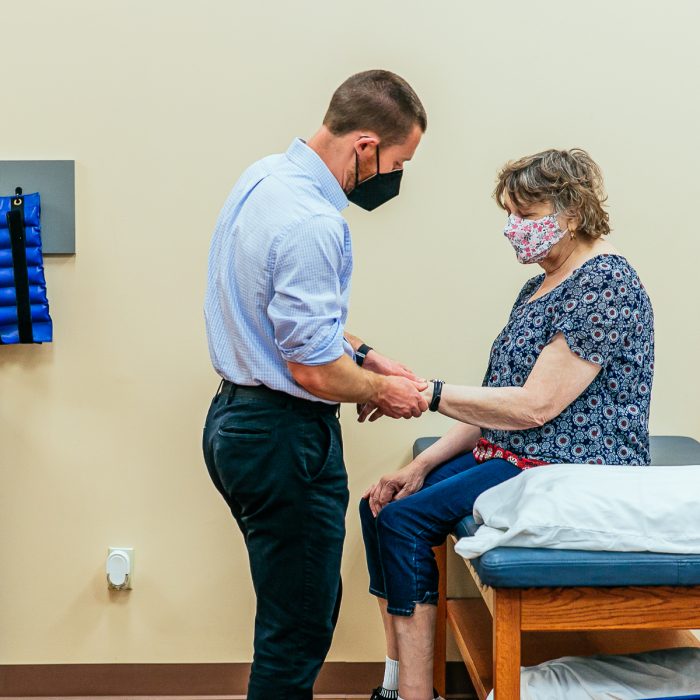
Here’s what PT treatment typically looks like for tennis elbow. Your therapist will assess grip strength, wrist extension strength, and the specific tendons involved. From there, treatment usually includes manual therapy to the forearm and elbow, progressive eccentric loading exercises, and activity modification advice tailored to your job or sport. Most patients see meaningful improvement within four to six weeks of consistent PT.
At Limitless Physical Therapy Specialists, we treat tennis elbow across all four of our locations. Whether you’re a recreational athlete who overdid it on the court, a tradesperson dealing with repetitive strain, or a fitness enthusiast who went too hard too fast, our orthopedic specialists build a plan around your specific situation, not a generic protocol.
If you’ve also been dealing with pain running from your shoulder to your elbow, or struggling with shoulder and elbow pain together, those patterns often connect. A thorough evaluation can sort out what’s driving what.
You don’t have to accept months of broken sleep as “just part of tennis elbow.” Together, we’ll create a plan that empowers you to heal faster and get back to doing the things you love.
Frequently Asked Questions
Should I wear a brace on my tennis elbow while sleeping?
A counter-force brace or wrist splint can help reduce nighttime strain on the forearm extensor tendons. It’s especially useful if you clench your fists during sleep, which loads the same muscles involved in lateral epicondylitis. Choose a brace that’s snug but not tight enough to restrict circulation, you should be able to slip a finger under it comfortably.
Is it better to ice or heat tennis elbow before bed?
Heat is the better choice at bedtime. Icing constricts blood vessels and can increase stiffness overnight, the opposite of what you need. A warm towel or warm bath before sleep increases blood flow to the tendon and relaxes the forearm muscles, which helps reduce that sharp morning pain many people experience with tennis elbow.
Why is my tennis elbow worse in the morning?
Muscles and tendons naturally stiffen during sleep as circulation decreases. If your arm is positioned overhead or pressed against the bed, the lateral epicondyle absorbs mechanical pressure throughout the night. That combination, stiffening plus pressure, is why the first grip of the morning (coffee mug, toothbrush) often causes the sharpest pain.
Can sleeping position actually delay tennis elbow healing?
Yes. A clinical study found that patients who kept their arm down at night healed faster than those who continued sleeping with the arm overhead. Among compliant patients, 82% remained pain-free at two-year follow-up. Sleep position is an often-overlooked factor in why acute tennis elbow becomes a chronic problem.
How long does tennis elbow take to heal?
With physical therapy, including eccentrics, stretching, and activity modification, most patients see meaningful pain and function improvement within 4–12 weeks, with full resolution in 3–6 months. Without treatment, 80–90% of cases resolve on their own within 6–24 months through natural tendon remodeling. Addressing nighttime aggravation can help shorten that timeline regardless of your approach.
Ready to get your tennis elbow under control? Sleep changes help, but a personalized plan gets you there faster. Schedule a free evaluation at any of our four locations and take the first step toward sleeping through the night again.
About the Author
Dr. Dan Bajus, PT, DPT
Dr. Bajus is the founder of Limitless Physical Therapy Specialists with over 15 years of clinical experience treating orthopedic and sports injuries. He has worked with more than 5,000 athletes and patients across four locations in the Rochester and Cortland, NY areas. Download the Limitless Life App for on-demand exercises and patient education.